Why Is My Angelfish Swimming Sideways?
As an Amazon Associate we earn from qualifying purchases.
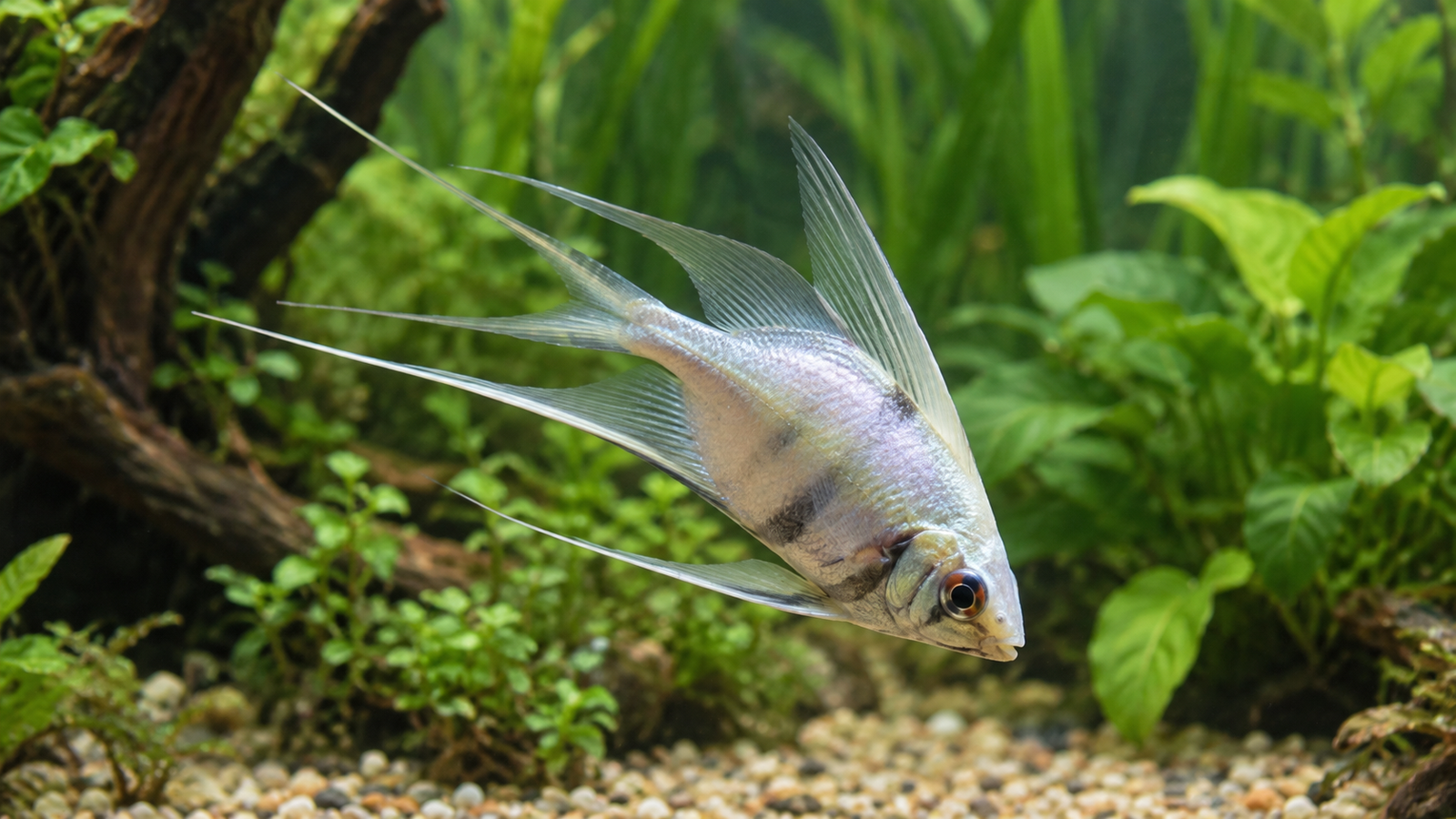
Why is my angelfish swimming sideways? An angelfish that swims sideways or tilts is showing an abnormal swimming position, and the cause can be water quality, a parasite, or a body problem that the sources do not describe in detail. The Merck Veterinary Manual lists “floating, drifting, or swimming erratically in unusual positions” as a common sign of illness in fish. No single cause can be confirmed from appearance alone, so the first steps are to check the water and to get a diagnosis from an aquatic veterinarian if the fish does not recover.
Quick answer
- Sideways or erratic swimming is listed by Merck as a common sign of illness in fish, so treat it as a symptom rather than a diagnosis.
- Test the water first. Merck says poor water quality is “the most common cause of environmental-related diseases in fish,” and the UF/IFAS ammonia guide says to test “immediately” when behavior changes.
- Merck describes a parasite that attacks angelfish muscle and causes “abnormal movement,” but a diagnosis needs microscopic examination of tissue.
- If the fish is still tilting after the water has been checked, or if other fish show the same signs, see an aquatic veterinarian or an experienced fish keeper.
What the sources say about sideways swimming
The Merck routine health care page describes illness signs in general terms. It says that “fish show signs of illness in a variety of ways” and that “some general signs of illness include changes in swimming behavior and noticeable changes in the color or condition of the body and fins.” Its list of common signs includes “floating, drifting, or swimming erratically in unusual positions.” That line is the closest match to a fish that swims sideways, but the page does not say which cause produces that position.
Because the sign is general, the sources do not allow a one-to-one link between sideways swimming and a single disease. A fish that tilts may be reacting to its environment, to a parasite that affects muscle, to an injury, or to a condition the sources do not cover. The sources opened for this guide describe some of these possibilities, but not all of them, and they do not describe a swim bladder condition in angelfish.
Start with the water
Water quality is the first thing to check, because the sources treat it as the most common environmental cause of disease in fish. The Merck providing-a-home page says that “poor water quality is the most common cause of environmental-related diseases in fish,” and it adds that water quality “should always be tested before adding fish to the aquarium.” The same page says that “prolonged ammonia exposure is highly toxic to fish,” and that nitrites are also toxic in high amounts.
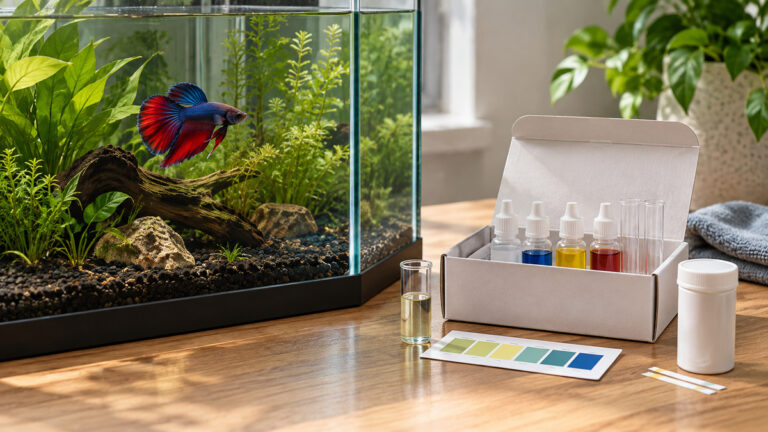
The UF/IFAS publication on ammonia in aquatic systems gives a clear timing rule. It says that “ammonia (and other water quality parameters) should also be tested immediately any time fish appearance or behavior changes (including reduced feeding).” A fish that is swimming sideways has changed its behavior, so the test should happen now, not after another day of watching.
Check the basic readings you can measure at home, such as ammonia, nitrite, nitrate and temperature. The sources do not give a safe range for angelfish, so compare your readings with the range on your test kit and ask an experienced fish keeper or an aquatic veterinarian if the numbers are unclear. For test options, see freshwater fish tank water test kits.
Temperature and equipment
Temperature problems can also cause stress. The Merck providing-a-home page says that “a heater is necessary for both freshwater and saltwater tropical fish,” and that the heater should be paired with “a separate thermometer in the tank to monitor water temperature independently from the heater.” Angelfish are tropical freshwater fish, so a heater that is not working or a thermometer that is not checked can lead to a stressed fish. The page also warns that “filters, pumps, heaters, and lights should not be turned on until after the tank is filled with water.”
Check the thermometer, the heater setting and the filter flow. If a fish is swimming sideways after a sudden change in the tank, the change is worth noting. The sources do not say how fast temperature can change before it becomes harmful, so keep changes small and gradual.
Parasites that affect movement
The Merck disorders chapter names angelfish directly. It describes a parasite, Pleistophora hyphessobryconis, that “attacks the skeletal muscle of neon tetra, angelfish, and other freshwater aquarium fish.” The text says that “muscle damage leads to abnormal movement,” and it adds that “examination of diseased tissue with a microscope is necessary to confirm the infection.” The same entry says that “there is no treatment” and that infected fish should be removed from the tank to prevent spread.
That entry is the strongest source link between angelfish and abnormal movement. It is also a reason not to guess. A fish that tilts may have a muscle problem that cannot be seen from the glass, and the only way to confirm it is a tissue examination. Speak with an aquatic veterinarian before you move the fish or add anything to the tank.
Other parasites in the chapter cause different signs. Several produce flashing, rapid breathing or “piping,” which is swimming near the surface to gulp air. A tilting fish that also breathes fast or rubs on objects should be looked at more quickly.
Injury, stress and new fish
A fish that has been recently added can be stressed or injured. The Merck providing-a-home page says that “adding the fish directly, without a gradual equalization of temperature, can cause shock and stress,” and that “aggressive behavior is stressful for all fish in the tank.” If the angelfish was chased, bumped or moved recently, a fin or body injury is possible. Look for torn fins, sores or scratches. The sources do not describe injury-related sideways swimming in angelfish, so treat injuries as a reason for a vet visit, not a reason to self-treat.
Gas bubble disease is another possibility the Merck chapter describes. It mentions “tiny gas bubbles in the cornea” and “tiny bubbles in the fins or gills” as signs, and it says a gill biopsy can confirm the diagnosis. Gas bubble signs are not swimming signs alone, so this is worth raising with a vet if you see bubbles in the eye or fins.
For a broader look at small, colorful community fish, see small colorful freshwater aquarium fish.
What to do next
The steps below are general guidance based on the sources, not a treatment plan.
- Test the water and note the readings with the time and date.
- Check the heater, thermometer and filter. Make sure nothing has changed recently.
- Watch the other fish. If more than one fish shows signs, the problem is more likely to be the water or a contagious condition.
- Do not add medication or change several things at once. Make one change, then watch.
- Contact an aquatic veterinarian if the fish does not improve, if it cannot right itself, or if other signs appear.
How we chose
The sources were chosen for the question, not for a product. This guide uses a veterinary reference and a university extension publication, all opened on 2026-10-24. Retail pages and forum posts were not used. A claim appears in the body only when a source states it, or when it is labeled as general guidance. The sources describe fish in general and one angelfish-specific parasite entry, so the guide keeps the angelfish-specific claim narrow.
What we could not verify
The sources do not diagnose sideways swimming in angelfish. They describe signs and causes in general terms, and they do not say which cause is most likely in a home tank.
What the sources do not say
- No source gives a safe water-parameter range for angelfish.
- No source describes swim bladder disorders in angelfish.
- No source gives a recovery time or a survival rate for a tilting angelfish.
- No source gives a treatment or dose that applies to this sign. This guide does not offer one.
- The sources do not say whether the Pleistophora entry applies to every angelfish with abnormal movement.
Frequently asked questions
Can poor water cause an angelfish to swim sideways?
The sources say poor water quality is the most common environmental cause of disease in fish, and they say abnormal behavior should prompt an immediate water test. They do not say that poor water causes sideways swimming in every case, so test the water and watch the fish.
Is sideways swimming always a parasite?
No. The Merck routine health care page lists erratic swimming as a general sign of illness. A parasite is one possibility described in the disorders chapter. Water quality, temperature stress and injury are others, and the sources do not rank them for angelfish.
Should I move the angelfish to a hospital tank?
The sources do not give a hospital tank procedure. Moving a sick fish can add stress, so ask an aquatic veterinarian before you move it.
Will the angelfish recover on its own?
The sources do not say. Some causes described in the Merck chapter have no practical treatment, so do not assume recovery. Get the fish checked if the sign continues.
When should I see a vet?
See an aquatic veterinarian if the fish is still swimming sideways after you have checked the water and equipment, if more than one fish shows signs, or if you see sores, bubbles or a swollen body. Describe the water readings and the timeline when you call.
Sources
- Merck Veterinary Manual, “Disorders and Diseases of Fish,” https://www.merckvetmanual.com/all-other-pets/fish/disorders-and-diseases-of-fish (opened 2026-10-24).
- Merck Veterinary Manual, “Routine Health Care of Fish,” https://www.merckvetmanual.com/all-other-pets/fish/routine-health-care-of-fish (opened 2026-10-24).
- Merck Veterinary Manual, “Providing a Home for Fish,” https://www.merckvetmanual.com/all-other-pets/fish/providing-a-home-for-fish (opened 2026-10-24).
- UF/IFAS Extension, “Ammonia in Aquatic Systems” (FA031), https://edis.ifas.ufl.edu/publication/FA031 (opened 2026-10-24).