Angelfish Tank Setup Ideas
As an Amazon Associate we earn from qualifying purchases.
Angelfish tank setup ideas start with one question: what does the fish need from its space? The best angelfish tank setup gives the fish stable heat, reliable filtration, places to rest and hide, and enough open water to move without bumping into décor. The sources checked for this guide describe these needs for fish in general. They do not give a minimum tank size or a layout for angelfish, so the ideas below are setup concepts built on those general statements and labeled as general guidance.
Quick answer
- Set up the tank in a stable spot away from direct sunlight, and fill it before turning on the filter, heater and light. The Merck Veterinary Manual says these should not be switched on “until after the tank is filled with water.”
- Use a heater with a separate thermometer. The Merck text says a heater is necessary for tropical freshwater fish, and a separate thermometer lets you check the temperature independently.
- Leave open swimming room and add plants or décor for territory. The sources say décor helps fish have their own territory.
- Allow the biological filter time to mature before adding fish, because the Merck text says the bacteria “will develop on their own in 4 to 6 weeks.”
Start with the frame and the location
A tank setup begins with the stand and the room. The Merck providing-a-home page advises that the aquarium be placed “in a location that you can get to easily for feeding, cleaning, and general maintenance.” It also says “the floor and the tank stand or cabinet must be strong, level, and stable,” and that a filled aquarium is heavy. Choose a spot where you can reach the front and back of the tank, and where the stand will not flex when the water is added.
Light and sun matter too. The Merck page says the tank “should be located out of direct sunlight,” because sunlight encourages algae and can raise water temperature. It adds that “the warmer the water becomes, the less oxygen it will hold.” Keep the tank away from windows, and use a light on a timer if you want a regular day and night cycle. The source says “fish need a day/night cycle for optimal health.”
Idea 1: an open tank with a clear front
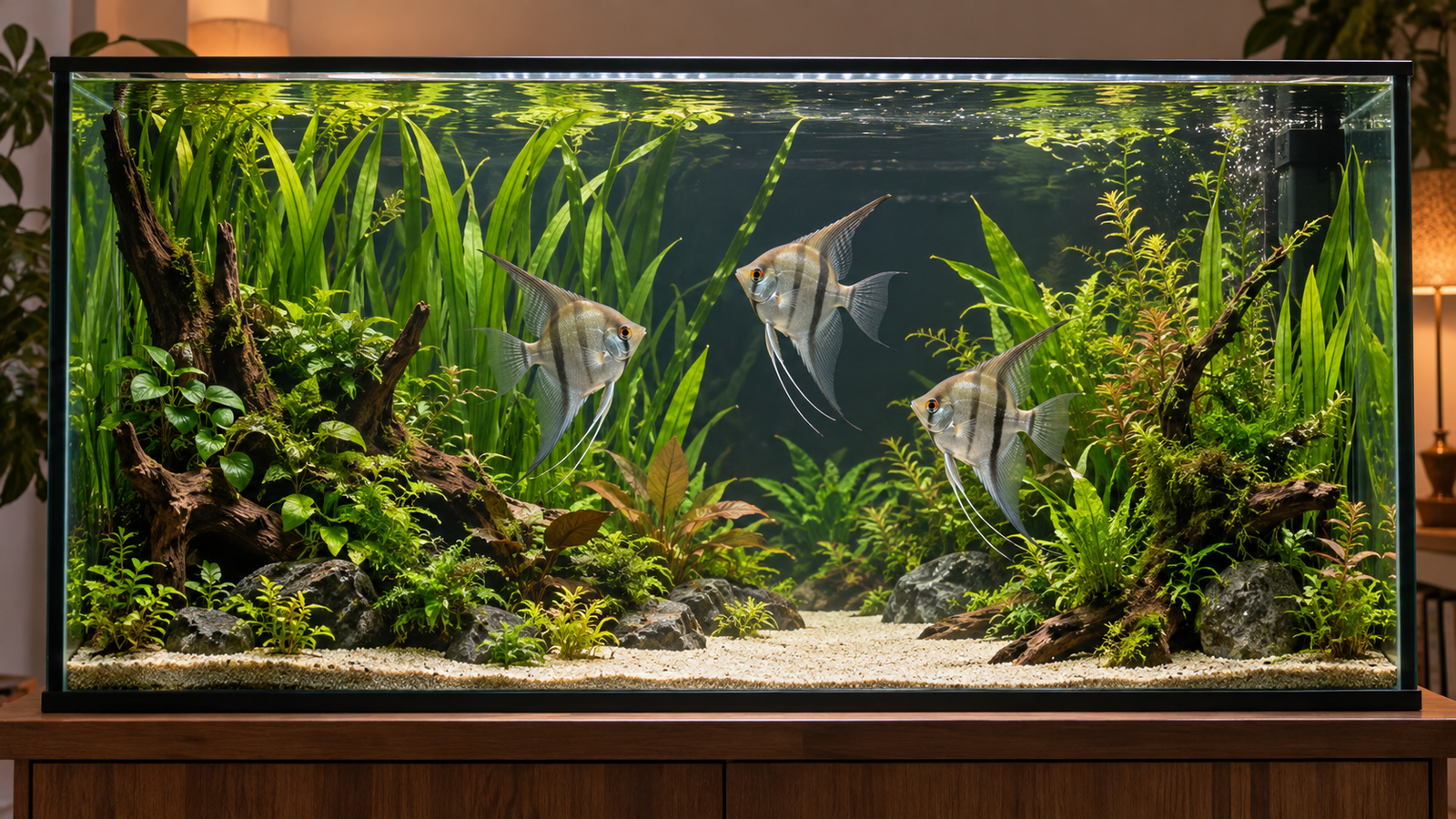
This setup keeps the center of the tank open and places the décor at the back and sides. It fits the Merck point that aggression toward new fish is common when “space and territory in the aquarium are at a premium.” A clear middle gives the angelfish room to swim without frequent contact with objects. The sources do not give a size for this layout, so the amount of open water is a judgment call.
Use the back and side walls for plants and rock or wood. The Merck page says that decorative objects “are not only aesthetically pleasing but also help “divide” the aquarium and allow fish to have their own territory.” That line supports placing décor as territory markers, not as a single pile in the center.
Idea 2: a planted tank with tall cover
Plants give fish cover and help control algae. The Merck providing-a-home page says that “aquatic plants also help prevent the growth of algae by absorbing nutrients that would otherwise feed the algae.” It also notes that floating plants “can also minimize temperature changes by shading the water.” For a planted angelfish tank, place taller plants at the back and leave the front open. Choose plants that can stand up to the lighting and to the fish; the sources do not name species suited to angelfish.
Tall plants at the back also help break up lines of sight, which can reduce chasing. This is general guidance. The sources do not measure how plants affect angelfish behavior.
Idea 3: a substrate that suits the plants
The substrate decision affects both the look and the maintenance. The Merck text says “usually, gravel is placed in a tank at a proportion of 1 pound of gravel per 1 gallon of water,” and that gravel should be rinsed “to remove any accumulated dust,” because dust “can prematurely clog filters and damage water pumps.” If you use a sand or gravel mix, rinse it the same way. The sources do not compare sand and gravel for angelfish, so choose by how you plan to clean and plant the tank.
Equipment: filter, heater and thermometer
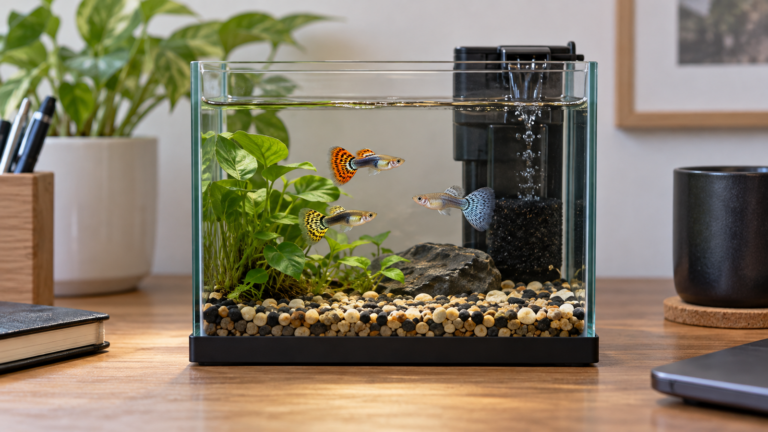
Filtration is the backbone of the setup. The Merck page says filtration “is important to remove waste and particulate matter,” and that under-gravel and hanging filters both house bacteria that “remove the primary fish waste, ammonia.” The page also says a heater “will typically have a programmable thermostat” and that a separate thermometer should be in the tank. Those two statements are the basis for a stable setup.
Do not switch equipment on early. The Merck text says that “filters, pumps, heaters, and lights should not be turned on until after the tank is filled with water,” because submersible pumps need water to stay cool and run safely. Plug in the heater after the tank is full, and check the thermometer rather than trusting the heater dial alone.
Cycling before the first fish
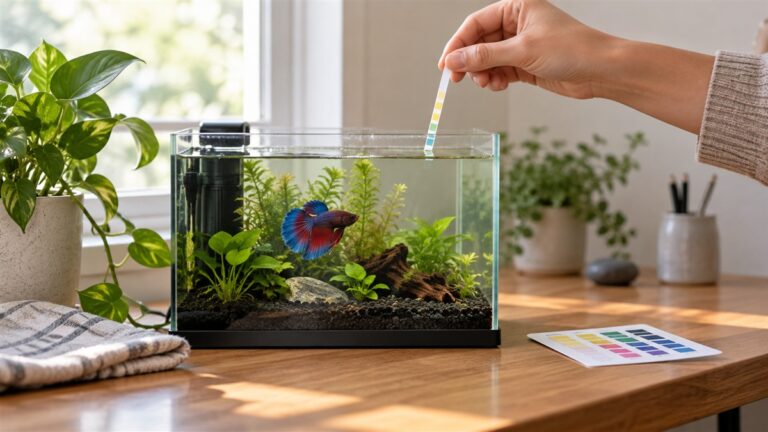
A new tank needs time for its biological filter to mature. The Merck providing-a-home page says that the bacteria “are common in the environment and will develop on their own in 4 to 6 weeks,” and that commercial products “may speed up the process slightly, but these are not necessary for most home aquariums.” Test ammonia and nitrite during this period. The Merck text says “prolonged ammonia exposure is highly toxic to fish,” and that nitrites are also toxic in high quantities.
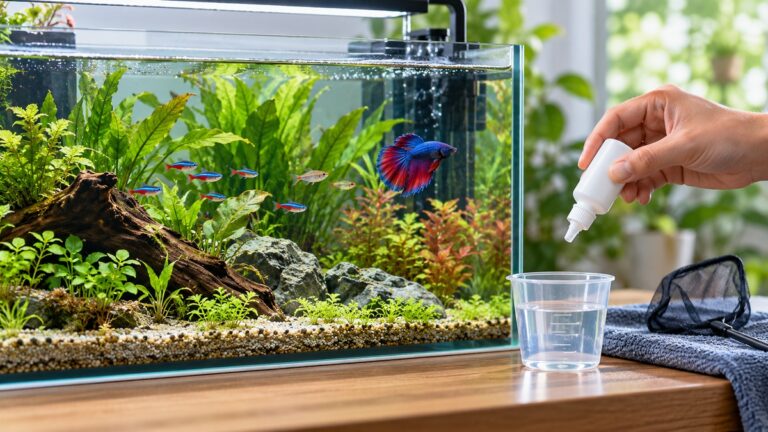
Once the tank has cycled, add fish gradually. The Merck text says that “adding the fish directly, without a gradual equalization of temperature, can cause shock and stress,” so float the bag for “about 20 to 30 minutes” before release. The source adds that “when new fish are added to the aquarium, the current residents sometimes respond aggressively,” so rearranging décor during the release may help.
Stocking and the fish you add
The Merck page gives a general freshwater stocking guideline: “1 inch of fish for every 12 square inches of surface area.” It is a rule of thumb for the whole tank, not an angelfish rule. Angelfish are commonly described as tall-bodied fish, which a surface-area rule does not measure, so the guideline may not describe how much room they need. This comment is general knowledge rather than a finding from the sources. The sources do not give a stocking rule for angelfish.
Mixing species needs care. The Merck introduction page says “different species may have requirements that differ greatly, and therefore they cannot be kept together,” and that “more aggressive species might attack or eat other fish in the tank.” Check the water and the behavior of each species before adding it. A tank that looks good on paper can still fail if the fish do not suit each other.
Feeding and water care in the setup
Feeding should match the tank. The UF/IFAS fish nutrition publication (FA096) says the most common mistake “made by pet owners is over-feeding their fish, often with resulting degradation of water quality.” A setup with a good filter still needs feeding restraint. Pick a food that suits the fish’s feeding position, and remove uneaten food. The Merck providing-a-home page says that “fish that prefer to feed at the bottom should not be fed flakes that float on the surface.”
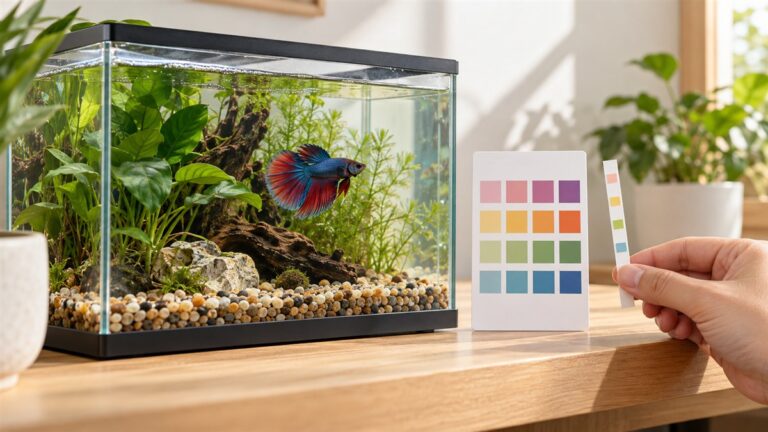
Water testing should be part of the routine. The Merck page says “poor water quality is the most common cause of environmental-related diseases in fish.” For test options, see freshwater fish tank water test kits. For a wider look at small, colorful community fish, see small colorful freshwater aquarium fish.
A simple setup order
The steps below are general guidance built on the sources above, not a tested build.
- Place the stand, check that it is level, and then position the tank out of direct sunlight.
- Rinse the substrate and add it. Place large décor before filling the tank.
- Fill the tank, then install and switch on the filter, heater and light.
- Add plants at the back and sides, leaving open swimming room in the middle.
- Run the tank until the filter has cycled, testing ammonia and nitrite.
- Add the fish gradually, using the float-and-release method.
How we chose
The sources were chosen for the setup question, not for a product. This guide uses a veterinary reference and a university extension publication, all opened on 2026-10-24. Retail pages, product listings and forum posts were not used. A claim appears in the body only when a source states it or when it is labeled as general guidance. The layout ideas are general guidance, because no source opened for this guide describes an angelfish layout.
What we could not verify
The sources describe aquarium setup for fish in general. They do not describe angelfish-specific needs, which makes the layouts in this guide the most speculative part.
What the sources do not say
- No source gives a minimum tank volume or height for angelfish.
- No source gives an angelfish temperature range.
- No source names plants that suit angelfish.
- No source recommends a specific filter flow for angelfish.
- No source says whether sand or gravel is better for angelfish.
Frequently asked questions
What is the best tank size for angelfish?
The sources checked for this guide do not give a minimum size for angelfish. The Merck stocking guideline is a general rule of thumb for surface area, and it does not account for tall body shape. Choose a tank that gives the fish room to swim and check with an experienced fish keeper or an aquatic veterinarian before buying.
Do angelfish need plants?
The sources do not say angelfish require plants. They do say that plants help control algae and can provide shade and cover. Plants and décor are useful as territory markers, but the sources do not rank them as necessary.
How long should I wait before adding angelfish?
The Merck page says that bacteria in a biological filter “will develop on their own in 4 to 6 weeks.” Test ammonia and nitrite during that period. Adding fish before the filter has matured can expose them to toxic ammonia.
Can angelfish live with other fish?
The sources say that different species may have different requirements, and that more aggressive species might attack or eat other fish. The sources do not give a list of compatible species for angelfish, so research each species and watch the tank after you add fish.
When should I contact a vet about my angelfish setup?
Contact an aquatic veterinarian if fish show signs of illness, such as changes in swimming or color, or if water tests show problems you cannot correct. Describe the setup and the water readings when you call.
Sources
- Merck Veterinary Manual, “Providing a Home for Fish,” https://www.merckvetmanual.com/all-other-pets/fish/providing-a-home-for-fish (opened 2026-10-24).
- Merck Veterinary Manual, “Introduction to Fish,” https://www.merckvetmanual.com/all-other-pets/fish/introduction-to-fish (opened 2026-10-24).
- Merck Veterinary Manual, “Disorders and Diseases of Fish,” https://www.merckvetmanual.com/all-other-pets/fish/disorders-and-diseases-of-fish (opened 2026-10-24).
- UF/IFAS Extension, “Fish Nutrition” (FA096), https://edis.ifas.ufl.edu/publication/FA096 (opened 2026-10-24).