How Much to Feed a Betta Fish: Portions and Schedule
As an Amazon Associate we earn from qualifying purchases.
How much do u feed a betta fish? According to the University of Illinois College of Veterinary Medicine, you feed once a day, and you give only as much as the fish can eat within 3 to 5 minutes, with no food left over. That rule is about time, not about a number of pellets, because pellet sizes and brands vary. This guide turns that one rule into a routine you can follow, and explains why the limit exists.
Quick answer
- Feed once a day.
- Offer only what the betta eats in 3 to 5 minutes.
- Remove or avoid leftovers, because uneaten food sinks and lowers water quality.
- Use a balanced pelleted or flaked food as the daily base, with high-protein treats only in moderation.
The rule in plain terms
The source describes bettas as carnivores that should receive a balanced pelleted or flaked food daily. It says to feed once a day and to give only what the fish can consume in 3 to 5 minutes. It does not give a count of pellets or a weight of flakes, and neither do we. A count that suits one food may not suit another, and the source leaves the decision to what your fish actually finishes.
In practice that means you start small and watch. Drop in a few pieces, set a timer, and see whether they are gone within the window. If food is still floating or has sunk after five minutes, you gave too much. Next day, give less. If everything vanishes in seconds and the fish keeps searching, you can offer a little more, still stopping at the point where nothing is left over after 3 to 5 minutes.
Why the limit matters
The source gives two reasons. First, bettas can become obese and develop other health problems if overfed. Second, leftover food sinks and degrades water quality, and toxins build up from waste and uneaten food. These two problems are connected: extra food either gets eaten and becomes extra waste, or goes uneaten and rots in the water. Either way the tank gets dirtier.
We will not go further than the source on health. If your betta looks bloated, stops eating or seems unwell, ask a vet. Our guide on how to tell if a betta fish is dying lists signs that sources describe, but it is not a replacement for veterinary advice.
A simple daily routine
Pick one feeding time
The source says once a day, so choose a time that is easy to keep, such as before work or in the evening. Feeding at about the same time each day makes it easier to notice a change in appetite, which is useful information to pass on to a vet.
Measure by the clock
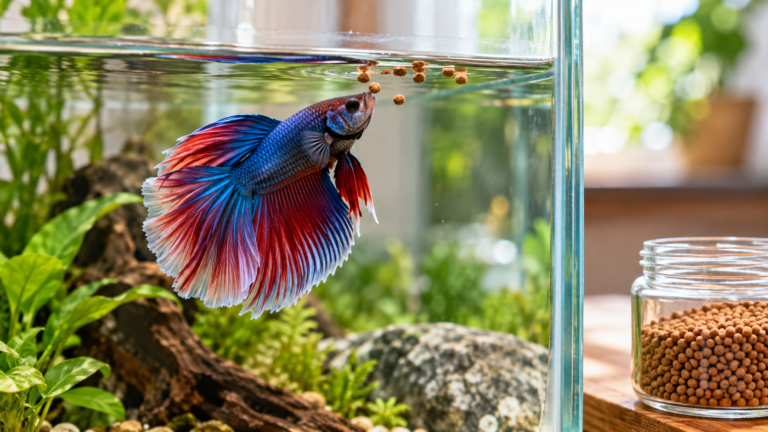
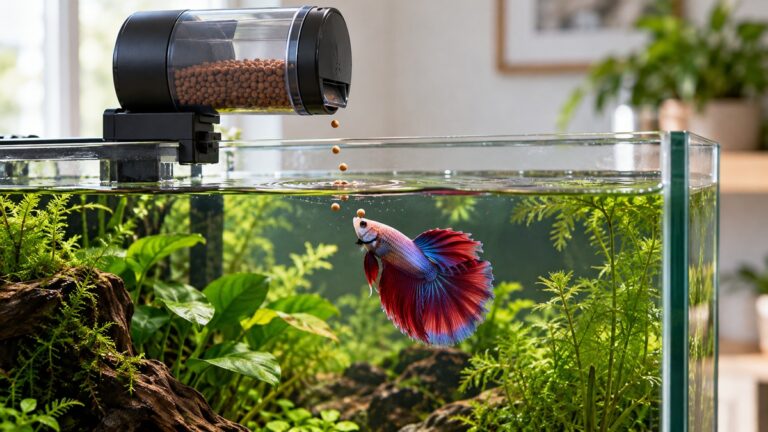
Use the 3 to 5 minute window. Watch the first minutes closely. Bettas eat from the surface in many setups, and the pieces you can see are the pieces you can count. Look at the bottom of the tank too, because sinking food is the food that harms water quality.
Remove what is left
The source says no food should be left over. If you see leftovers after five minutes, take them out with a net or a clean spoon rather than leaving them to break down. Next time, reduce the amount.
Write it down
A short note of how many pieces were eaten in time helps you keep the amount steady from week to week. There is no need for a chart. A count in your phone is enough.
What to feed
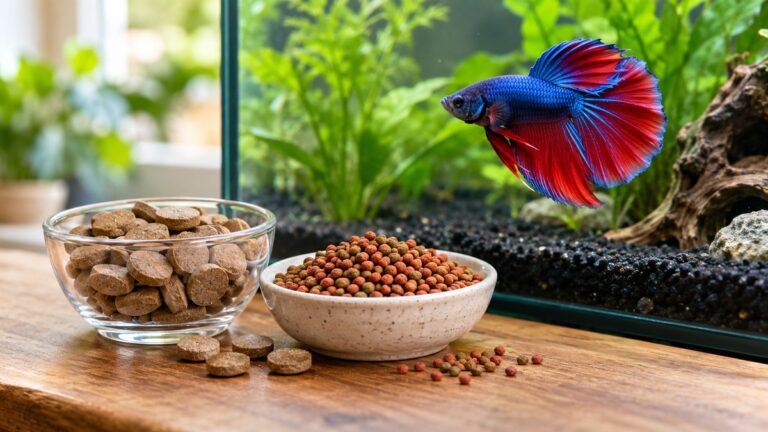
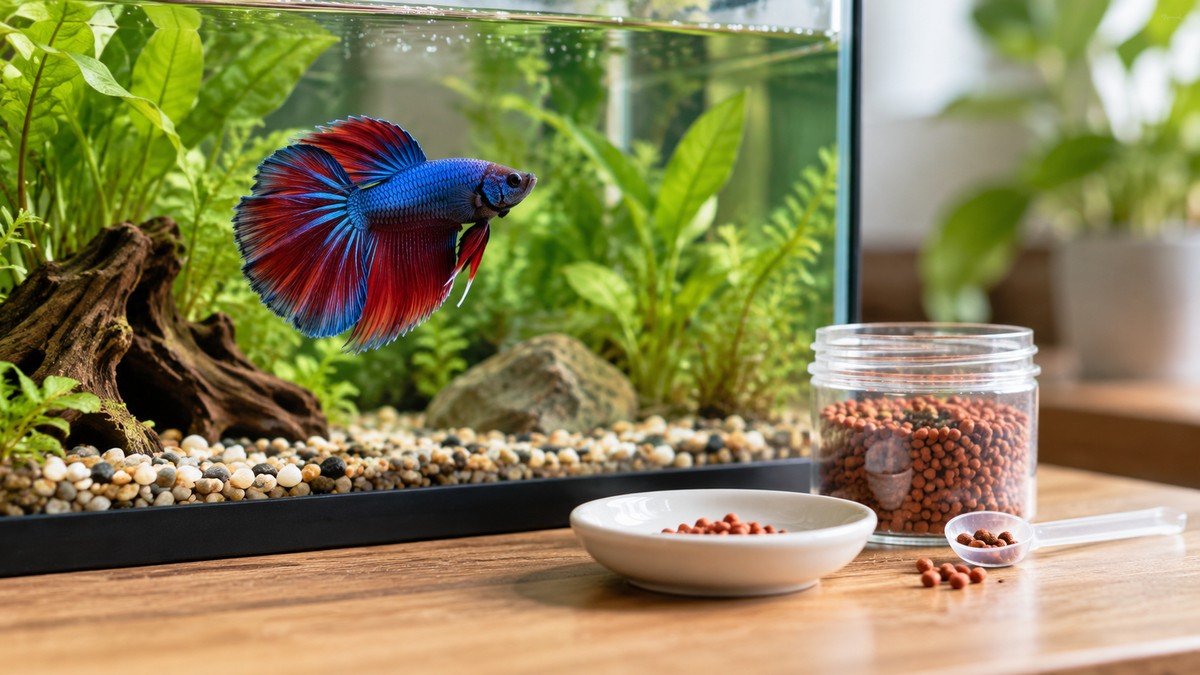
The base diet, according to the source, is a balanced pelleted or flaked food. Treats such as bloodworms or brine shrimp, live or freeze-dried, are fine in moderation because they are high in protein. Plants are not a food source for a betta; the source says so directly. Wikipedia's article on the species agrees that wild bettas are carnivorous and eat zooplankton, small crustaceans and insect larvae.
The sources do not give a ratio of treats to base food, so we will not invent one. Treats count toward the 3 to 5 minute limit. If you give a treat, reduce the main food.
What about fry and young fish?
Wikipedia notes that young bettas digest carbohydrates poorly and prefer live, moving prey such as baby brine shrimp over commercial feeds. It does not give a schedule for fry, so the once-a-day rule above is for the adult betta described in the veterinary guide. Our guide on whether betta fish grow covers size, and for general feeding information see how much and how often to feed betta fish.
Water and temperature matter too
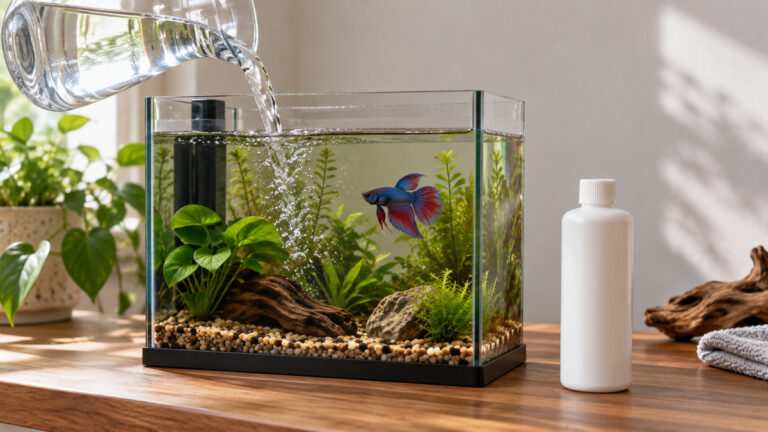
Feeding does not stand alone. The same Illinois source says bettas should not live in bowls, recommends a tank of at least 5 gallons, and gives a water temperature of 76 to 81 degrees Fahrenheit, noting that most homes are too cool so an in-tank heater is usually needed. It does not give a water change schedule, so we do not either. Read what temperature betta fish like for more on the heat side.
The reason this matters for feeding is that the source ties leftover food to water quality. A clean, correctly sized tank gives the fish a better chance to use the food you offer, and a dirty one makes overfeeding more costly.
Common mistakes
- Feeding more than once a day because the fish "begs." The source says once a day.
- Using a fixed pellet count without watching the clock.
- Leaving leftovers to sink.
- Treating treats as extra. They count toward the same limit.
- Feeding plant matter as the main diet. The source says plants are not a food source.
FAQ
How much do u feed a betta fish each day?
Only what it can eat within 3 to 5 minutes, once a day, with no food left over.
How many pellets is that?
The sources do not give a number. Start with a few and adjust until the food is gone inside the window.
Can I feed my betta twice a day?
The veterinary source says to feed once a day. It does not describe a split schedule, so we do not recommend one.
Are treats okay?
Yes, in moderation. The source names bloodworms and brine shrimp, live or freeze-dried, as high-protein treats.
What happens if I overfeed?
The source says bettas can become obese and develop other health problems, and that uneaten food sinks and degrades water quality. Ask a vet about any health concern.
Should I feed my betta when I go away?
The sources cited here do not cover this. Ask a vet or a knowledgeable hobby store.
Bottom line
Feed one balanced meal a day, sized by the clock: whatever your betta finishes in 3 to 5 minutes, nothing more, nothing left behind.