Can Betta Fish Live With Neon Tetras? Tank Mate Guide
As an Amazon Associate we earn from qualifying purchases.
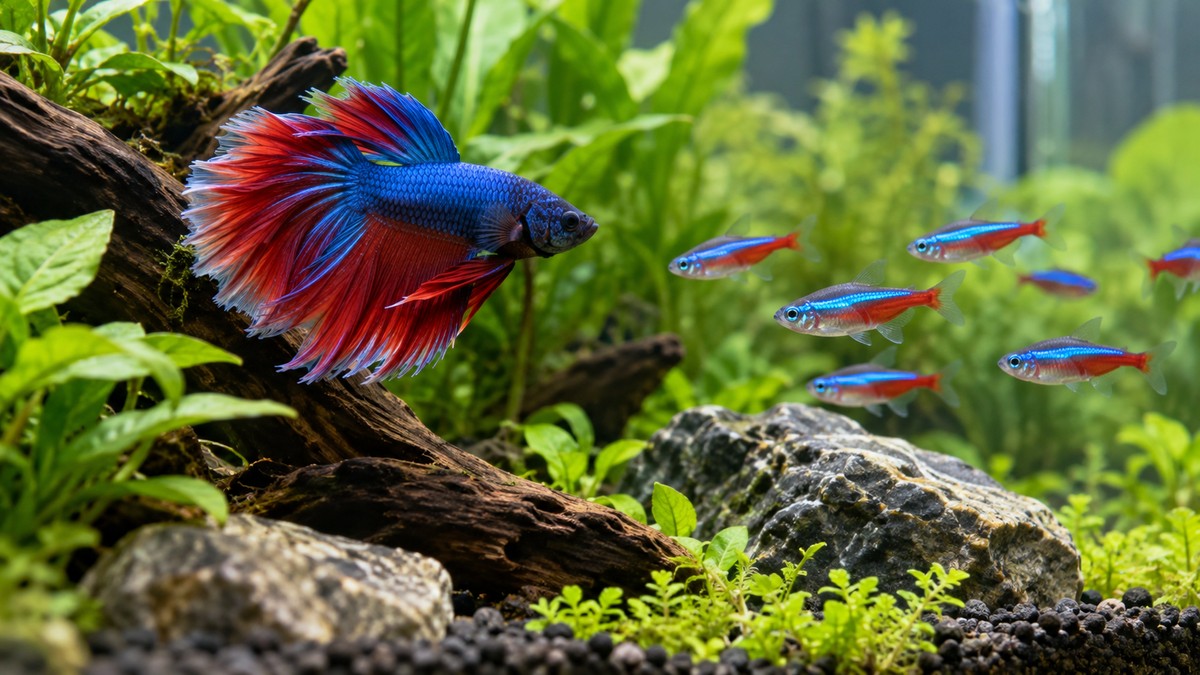
Can betta fish live with neon tetras? Sometimes, and it depends on the tank and on the individual betta. The reference article on bettas says they are compatible with many other species of aquarium fish, and that they are mainly aggressive toward smaller, slower fish. Neon tetras are small, but they are also quick shoaling fish, and they need a group, a decent tank and a temperature range that suits them. This guide goes through what the sources say, where they stop, and how to decide without gambling with the fish.
Quick answer
- It can work in a tank of at least 10 gallons, which both sources give as a minimum, with a group of at least six neons.
- It is not guaranteed: males are described as highly territorial, and each betta has its own temperament.
- A single neon is a poor plan. The tetra reference says to keep at least six.
- If the betta chases or nips, separate the fish. Ask a vet who treats fish about injuries.
What the sources say about the betta
The Wikipedia article on the Siamese fighting fish makes several points that matter here. Bettas are described as compatible with many other aquarium fish, contrary to popular belief. Males are highly territorial toward other male bettas, and with proper conditions bettas are aggressive mainly toward smaller, slower fish such as guppies. A betta tends to claim a territory centered on a plant or rocky alcove, which means decor and plants give it places to establish territory. Males may flare at their own reflection. And if a betta is housed with other fish, the article recommends at least 45 litres, about 10 gallons.
What the article does not do is give a ranked list of safe tank mates or promise how a given fish will react. So the honest reading is that the betta is not a guaranteed menace, and also not a guaranteed good neighbor.
What the sources say about the neon tetra
The Wikipedia article on the neon tetra gives these points:
- Adults reach about 4 cm (1.6 in).
- They are shoaling fish. Keep at least six, though they are noticeably more active in groups of eight to 12 or more.
- A minimum of 10 US gallons (38 L) is recommended, and a densely planted tank best mimics the native habitat.
- The aquarium temperature range given is 72 to 76 degrees F (22 to 24 C).
- On water, the article lists general hardness below 10 dGH, carbonate hardness of 1 to 2 dKH and nitrate under 20 ppm. It gives conflicting pH figures: one source says ideal is 7.0 and tolerable from 6.0 to 8.0, another recommends 6.0 to 7.0.
- They are omnivores that accept small flake, with small live or frozen foods as a supplement.
- They usually live only two to three years in an aquarium, and they can get neon tetra disease, which the article calls generally incurable and often fatal. Quarantining new fish is the main prevention.
The tetra article also does not describe temperament directly. Its behavior notes are limited to shoaling, and to the fish dulling its color at night and becoming active again in the morning.
Where the two fish line up
| Point | Betta (per source) | Neon tetra (per source) |
|---|---|---|
| Minimum tank with other fish | About 10 gallons (45 L) | 10 US gallons (38 L) |
| Group size | Males kept apart from other males | At least 6, better 8 to 12 |
| Temperature | Not stated as care guidance in the source | 72 to 76 F (22 to 24 C) |
| Behavior | Territorial; aggressive mainly to smaller, slower fish | Shoaling; behavior otherwise not described |
| Size | Not stated in the source | About 1.6 in (4 cm) |
The table shows the practical issue: the 10 gallon minimum matches, so a tank at or above that size is the starting point. The temperature row has a gap. The betta article describes wild conditions only, so check your betta’s care guidance for a temperature and compare it with the tetra range before you buy anything. If the two do not overlap comfortably, do not combine them.
Why group size matters more than people expect
A lone neon is stressed by lack of company, and it makes a single target for a betta. A group spreads attention and lets the tetras behave as a school. The tetra source says they are more active in groups of eight to 12 or more. That also raises the question of room: a school of that size plus a betta in a small tank is crowding. Overstocking is a common cause of water problems, and the aquarium filtration reference notes that ammonia buildup from decomposing waste is a leading cause of fish deaths in new, poorly maintained or overstocked tanks. More fish means more waste and more water changes.
See our notes on feeding for the betta side: can you overfeed a betta fish. In a shared tank the risk is higher, because food meant for one fish ends up in the water with the others.
Layout: territory and escape routes
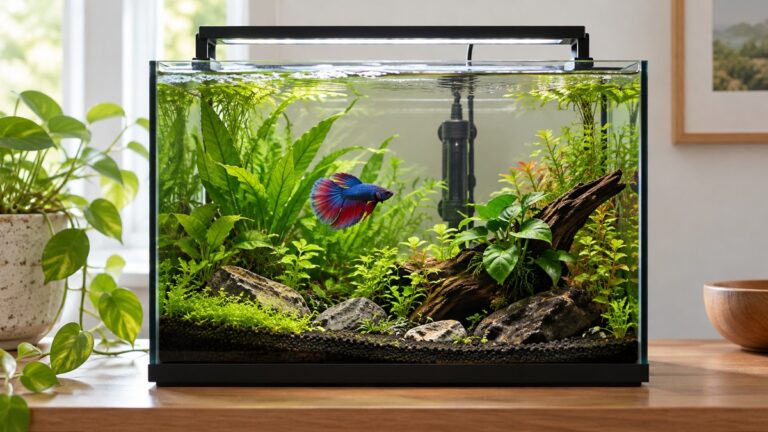
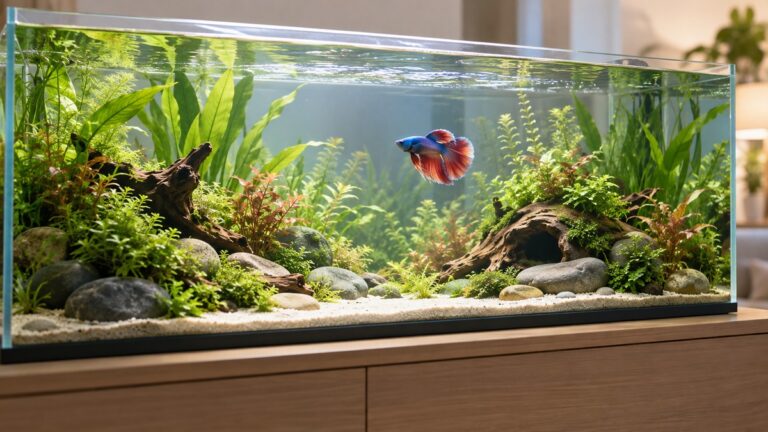
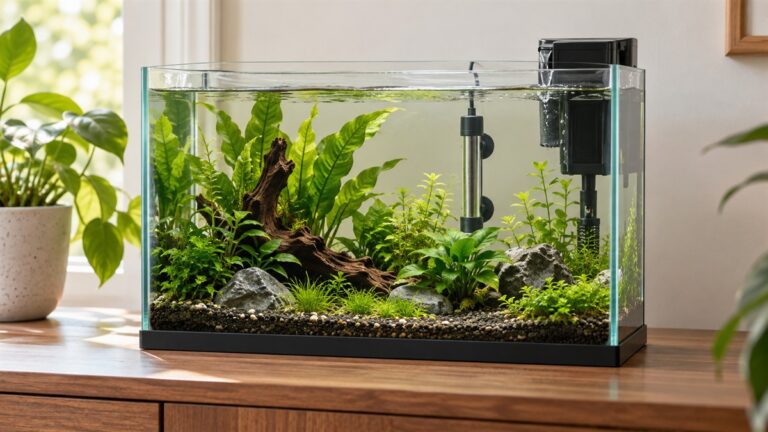
Because the betta article says bettas claim a territory centered on a plant or alcove, a tank with several plants and hiding places is more useful than open space. Dense planting also matches what the tetra source says about the native habitat. The goal is for each fish to have somewhere to retreat. A bare tank with a heater and a filter leaves nowhere to hide.
Flow matters too. If you add a filter, check it is not too strong for a betta. Our guide to aquarium filter current that is too strong explains how to read the listings for that.
Water and temperature: a mismatch to check
Water changes and conditioning matter whichever fish you choose. See can betta fish live in tap water and bottled water for betta fish for those questions. On temperature, our page on whether a betta can live in cold water, can betta fish live in cold water, covers what the sources say. Compare the range you settle on to the neon range of 72 to 76 F given above.
Signs it is not working
- The betta chases or nips the tetras, or the tetras hide constantly.
- The tetras lose their color or stop schooling.
- A fish has torn fins or marks. Do not treat this yourself; ask a vet who sees fish.
- The betta flares at tank mates all day. The reference notes pale horizontal bars show up in stressed or frightened bettas of both sexes.
If you see these, have a second tank or a divider ready. It is much easier to separate fish early than to fix an injury.
Before you add the neons
- Confirm the tank is 10 gallons or more.
- Plan to buy at least six neons, and know where the group will live.
- Check that your temperature plan suits both species.
- Quarantine new fish, as the tetra source recommends, since neon tetra disease is generally incurable.
- Add plants and hiding places before the fish.
- Watch the first days closely.
FAQ
Will a betta kill neon tetras?
The betta article says bettas are mainly aggressive toward smaller, slower fish. Neons are small but the sources do not describe them as slow, and nothing guarantees how a given betta will behave. Some will ignore them, others will not.
How many neon tetras should go with one betta?
At least six, according to the tetra reference, and more is better. That is why a 10 gallon tank is the floor rather than the target.
Can I keep one neon tetra with my betta?
The source says to keep at least six. A single neon goes against that and leaves one small fish for the betta to focus on.
Do they need the same temperature?
The tetra source gives 72 to 76 F. The betta article does not give a care temperature, so check your betta’s care guide and make sure the ranges overlap.
What if my betta is aggressive?
Keep it alone. Males are described as highly territorial, and there is no rule that says every betta will tolerate company.
Is the tank size really important?
Both sources give a 10 gallon minimum for keeping these fish with others. Smaller tanks leave less room to retreat and less water to dilute waste.
Bottom line
Try it only in a planted tank of 10 gallons or more, with a school of at least six neons and a matching temperature, and be ready to separate the fish. If you cannot meet all of that, keep the betta alone.
Sources
Siamese fighting fish (Wikipedia); Neon tetra (Wikipedia); Aquarium filter (Wikipedia)