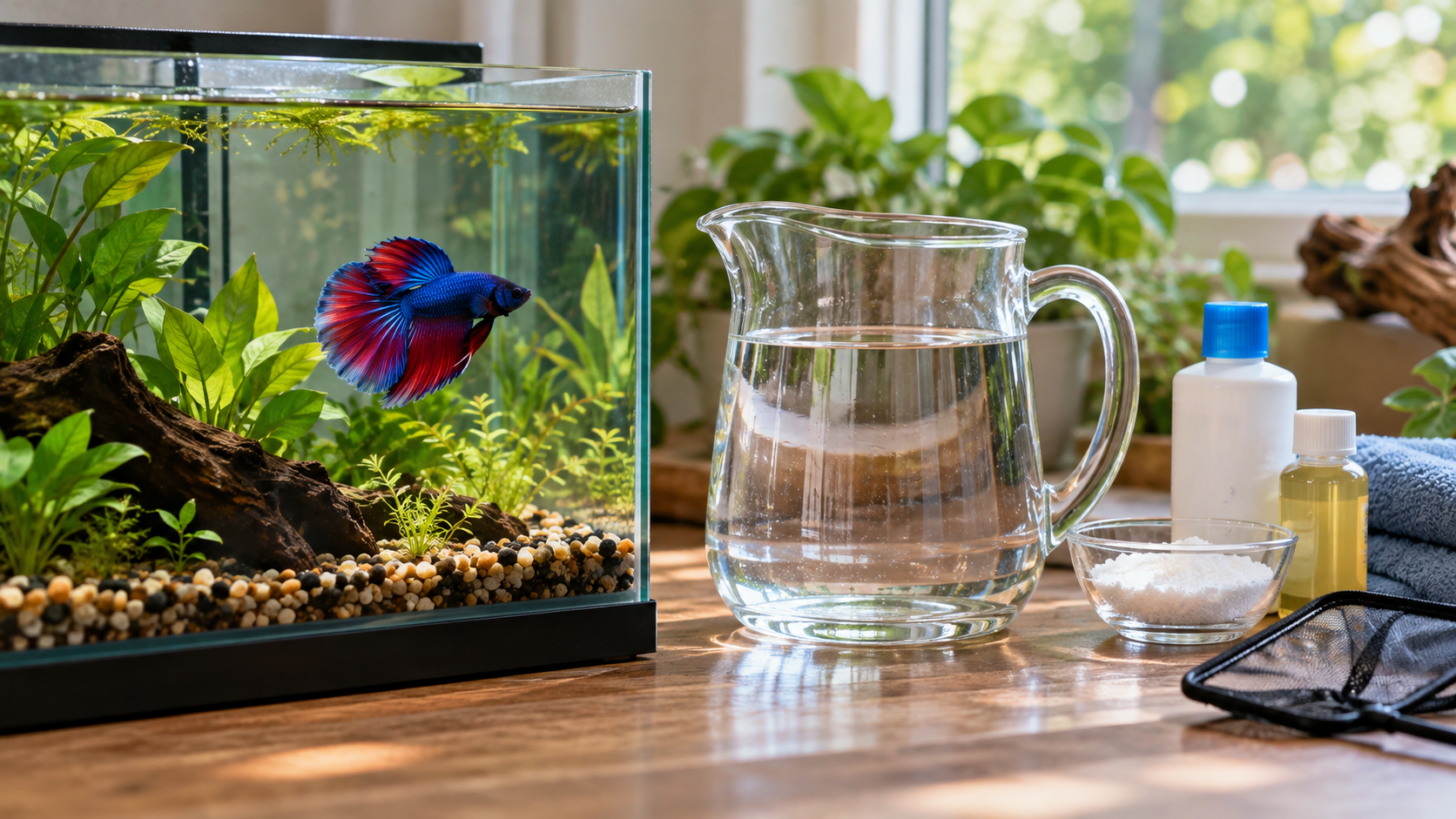
Is Distilled Water Good for Betta Fish?
As an Amazon Associate we earn from qualifying purchases.
The person typing “is distilled water good for betta fish” wants a clear answer about whether to use distilled water in a betta tank. The sources opened for this guide do not say that distilled water is good or bad for bettas, so no sourced yes or no exists. They do explain what distilled water lacks, why buffering matters, and why any new water should be tested before a fish goes in. Those points give a basis for deciding, and they are set out below.
Quick answer
- No opened source says distilled water is good or bad for betta fish.
- Merck says necessary minerals are “not found in tap, filtered, or distilled water,” although that line is about salt for marine tanks.
- IFAS says alkalinity buffers pH, and that once alkalinity is depleted “pH of the water can drop significantly and quickly.”
- Test any water before use, including distilled water, and match its temperature to the tank.
What the sources say about tap water
The Merck Veterinary Manual describes tap water as a starting point that often needs treatment. It says that “Most city water is treated with chlorine or a combination of chlorine and ammonia (known as chloramine), both of which are toxic to fish.” It adds that “Additives (dechlorinators) are available to remove both chlorine and chloramine from the water.” Distilled water is not treated tap water, so it does not need this step for chlorine, but the sources say nothing about whether distilled water is safe for a betta without a further check.
The same page notes that “Dissolved minerals can also lead to excess algae growth.” That is a sourced point about minerals in general. It does not say that less mineral water is safer for a betta, and it does not say that a betta needs minerals.
What distilled water lacks
The Merck page explains that “Commercial salts provide not only salinity but also necessary minerals and elements that are not found in tap, filtered, or distilled water.” That line is written about salt for a saltwater tank, where salt is added on purpose. It shows that distilled water does not carry the minerals that the salt provides. It does not show that bettas need those minerals.
The same passage notes that “Commercial salts also raise the pH of the water and help buffer it to keep the pH stable.” That brings in buffering, which is the next point.
Buffering, alkalinity and pH
The IFAS ammonia publication explains the buffering link. It says that nitrification is an aerobic process, which can lower pH, as the source puts it: “reducing the pH of the water unless sufficient buffers (alkalinity) are present.” It also says that “At a total alkalinity less than 20 milligrams per liter (mg/L), common species of nitrifying bacteria do not function effectively.” And it warns that once alkalinity is depleted, pH can fall significantly and quickly, which can kill both fish and nitrifying bacteria.
The IFAS text is about aquaculture systems, not betta tanks. Still, the logic applies: water with little buffering can change pH more easily. Whether distilled water in a given tank will be low in buffering is not something the sources state. A water test can check it.
For a betta-specific view of the pH question, see the freshwater test kit guide, which covers the kinds of tests that matter for this decision.
What the wild habitat shows
The IFAS betta publication describes the wild habitat of the betta, which had “heavy emergent vegetation, shallow water, low dissolved oxygen, high temperature, and an acidic pH.” That is habitat context, not a recipe for a home tank. It does not say whether soft or mineral-poor water is better for a betta, and it should not be read as a recommendation for distilled water.
Testing before any water goes in
The one step the sources agree on is testing. The IFAS ammonia publication says that “a good ammonia test kit will include a TAN test, a pH test, and a thermometer.” It also notes that the toxic fraction of ammonia depends on “the temperature and pH of the water.” So a test kit and a thermometer are the minimum for judging any new water.
The Merck page says water quality must be routinely monitored for chlorine, pH, temperature and salinity. Salinity does not apply to freshwater bettas, but chlorine, pH and temperature do. Check those three before any water change.
The IFAS betta publication also states that “Water quality is a critical consideration for ensuring the health and longevity of aquarium fish.” It adds that “water quality is not dependent on the size of the container, but rather on management and husbandry.” Management is the key concept here, and it applies to whatever water you choose.
Practical steps if you use distilled water
If distilled water is used at all, the sources support a short routine built on testing. The Merck maintenance schedule lists a daily task of “Check fish, water temperature, and equipment.” Check the temperature of any new water against the tank before it goes in, because the IFAS ammonia text notes that the toxic share of ammonia depends on temperature and pH. Test the tank before and after a change to see what the water does.
Keep a simple record of each reading. A written record shows whether pH falls between changes, which turns the IFAS point about buffering into something you can see in your own tank. This record-keeping step is general guidance. A steady drop in pH is a reason to review the water source and the filter, not a reason to guess at additives.
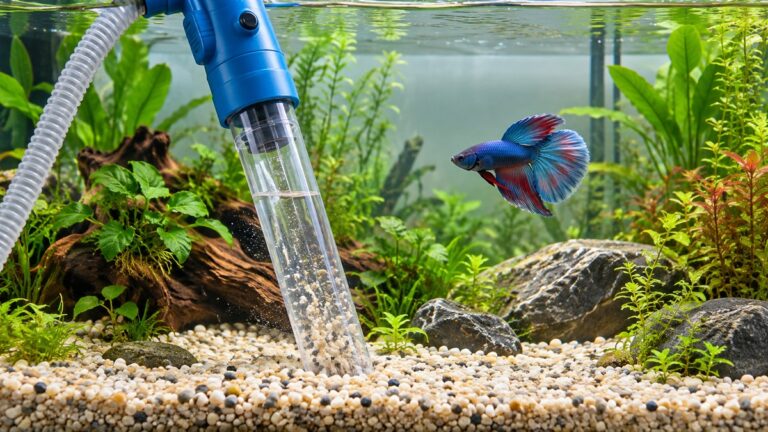
For the cleaning routine that goes with any water change, see the guide to cleaning a betta fish tank.
How we chose
The criteria for this guide were fixed before the reading. The sources had to be university or veterinary references that discuss water chemistry or fish husbandry. Retail pages were excluded, and no product or brand is recommended. Each quotation was checked against the text of a page opened on 2026-10-24.
What we could not verify
The sources do not answer the central question. They do not say whether distilled water suits a betta, whether a betta needs any mineral content, or what hardness and buffering a betta tank should have. Those points need a source that discusses betta water chemistry directly.
What the sources do not say
- Whether distilled water is good or bad for betta fish.
- A betta-specific hardness or alkalinity target.
- Whether a betta does better in soft or hard water.
- How much buffering distilled water has once a fish is added.
Frequently asked questions
Can I use distilled water for a betta tank?
The sources opened do not give a sourced answer. They do say that water must be tested before a fish goes in, and that chlorine, pH and temperature should be checked. Distilled water should be tested in the same way as any other water before use.
Does distilled water change the pH in a tank?
The sources do not state this for betta tanks. The IFAS ammonia text explains that buffering, or alkalinity, keeps pH stable, and that low alkalinity lets pH drop quickly. Testing pH before and after a water change shows what a given tank does.
Do betta fish need minerals in their water?
The sources do not say bettas need added minerals. The Merck page says commercial salts supply minerals that tap, filtered or distilled water lack, but that is written for marine salt. Ask a source on betta water chemistry before adding minerals.
Is tap water safe for a betta without treatment?
The Merck page says city water is commonly treated with chlorine or chloramine, which are toxic to fish, and that dechlorinators remove them. Treat tap water before use, and test it, as general guidance.
What should I test before a water change?
The IFAS ammonia publication names a TAN test, a pH test and a thermometer as the minimum for judging ammonia risk. Chlorine should be checked as well, as Merck advises. Test the new water and the tank before a change.
Sources
- Providing a Home for Fish, Merck Veterinary Manual, opened 2026-10-24.
- Ammonia in Aquatic Systems (UF/IFAS FA031), opened 2026-10-24.
- Evolution, Culture, and Care for Betta splendens (UF/IFAS FA212), opened 2026-10-24.