How to Transfer Goldfish to a New Tank
As an Amazon Associate we earn from qualifying purchases.
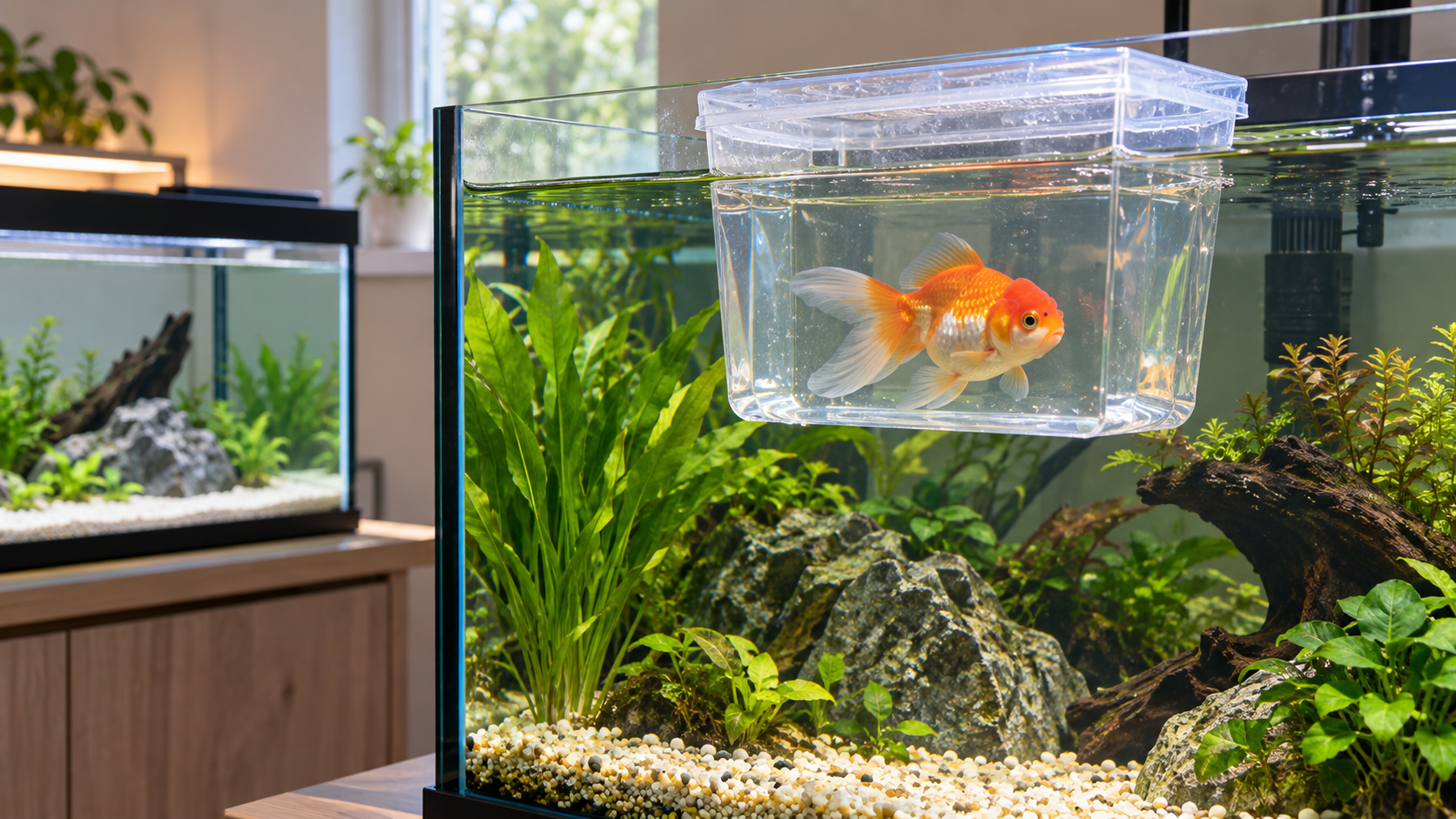
How to transfer goldfish to new tank: float the sealed bag or container in the new water until the temperatures match, then release the fish gradually. Merck says adding a fish directly, “without a gradual equalization of temperature, can cause shock and stress.” The new tank also needs to be ready before the fish arrives, because the beneficial bacteria that handle waste “will develop on their own in 4 to 6 weeks.” Plan the move so the tank has time to settle.
Quick answer
- Float the bag in the new tank for about 20 to 30 minutes so the water temperature can equalize, as Merck describes for new fish.
- Avoid adding the goldfish straight into the new water, since Merck links that to shock and stress.
- Set up the new tank ahead of time, because the sources say beneficial bacteria take 4 to 6 weeks to develop on their own.
- Do not overfeed after the move, and remove any uneaten food each day.
Prepare the new tank before the fish moves
Merck’s guidance on setting up a home for fish puts the water first. It says that “Beneficial bacteria feed on various wastes in the aquarium or pond,” and that these wastes include “uneaten food, decaying plant matter, and fish feces, or chemical wastes that the fish excrete—primarily ammonia.” Merck adds that “Prolonged ammonia exposure is highly toxic to fish.” A new tank that has not developed its bacteria can be a dangerous place for any fish, so the setup should be finished and running before the goldfish is introduced.
Merck also says “These bacteria are common in the environment and will develop on their own in 4 to 6 weeks.” It notes that “Commercial products may speed up the process,” but the sources checked do not describe any product in detail. The practical rule is simple: give the tank time to run and check the water before moving the fish. Merck also advises that the aquarium be placed “in a location that you can get to easily for feeding, cleaning, and general maintenance,” which is worth settling before the move.
Acclimate the fish to the new water
Acclimation is the step most people rush. Merck describes floating the bag “to allow the temperature of the water in the bag to equalize with the temperature of the water in the tank or pond (about 20 to 30 minutes).” Adding the fish directly, it warns, “can cause shock and stress.” The float gives the fish time to adjust before it leaves the bag.
Merck also describes a second approach for fish that may be harassed when added to an established tank. It says to rearrange the decorative objects while the bag floats, because this “helps break up established territorial markers.” Merck adds that a fish can be released in the dark, since “most fish will go into a ‘rest’ mode within a few minutes.” Those tricks are described for aggressive or territorial situations, and the sources do not say they are needed for every goldfish.
The sources checked do not give a separate method for goldfish, so the general float-and-release approach is the one the sources support.
Move the fish with as little stress as possible
Merck’s suggestion to release the fish in the dark is one way to lower stress. The sources checked do not give an exact temperature range for goldfish, so check the new tank with a thermometer and match the bag water to it before release.
The sources do not give a time limit for keeping a fish in the bag, so the goal is to release it once the temperatures match.
Feeding and monitoring after the move
Do not feed heavily on the day of the move. Merck says that “Overfeeding can lead to health problems as well as a dirty tank,” and that feeding rates “vary with species, age, system, and water temperature.” A new tank adds stress, so a small portion is safer than a large one. Merck’s routine list says to “Feed fish and remove any uneaten food,” which is a practical daily check after the transfer.
Watch the fish for the first few days. Merck lists common signs of illness in fish, including “Not eating,” lethargy, “Slow or rapid breathing” and “Loss of color.” A goldfish that shows these signs after a move needs a closer look at the water and the setup. Merck’s guidance is that complicated problems need veterinary care, so an experienced fish keeper or an aquatic vet is the right person to ask. Do not treat a sick fish with medication based on this guide.
Check the water regularly
Merck’s preventive care advice is that the best way to keep fish healthy includes “monitoring the water quality, and maintaining a regular schedule of cleanings, water changes, and filter replacements.” It also says to check “fish, water temperature, and equipment” daily. Those routine checks give an early warning if the new tank is not settling well.
The sources checked do not state a specific water-change schedule for a goldfish tank, so the owner should follow the product label for filters and the advice of an experienced fish keeper for the schedule. The guide on how big of a tank do betta fish need covers tank size for a different species, which is a useful reminder that each fish has its own space needs. The guide on do betta fish need a heater covers temperature for a tropical species.
How we chose
This guide is based on four sources opened on 2026-10-24: two Merck Veterinary Manual fish care pages covering home setup and routine health care, and two FishBase species summaries. No retail listings, prices or product ratings were used. The steps come from what those pages say about temperature equalization, bacterial development, feeding and signs of stress or illness.
What we could not verify
The sources do not give a goldfish-specific transfer protocol, a tank size for goldfish or a required water temperature. They also do not name a product that speeds up cycling, so no claim is made about any specific product.
What the sources do not say
The sources do not say how long a goldfish can stay in a bag, how much water change is needed after a move, or which filter suits a goldfish tank. FishBase lists the goldfish’s habitat conditions, but the summary does not turn them into a home aquarium setting. Those questions need a product manual, a local fish keeper or an aquatic vet.
Frequently asked questions
How long should I float a goldfish in a bag?
Merck describes floating the bag about 20 to 30 minutes so the water temperature equalizes. The sources do not give a separate rule for goldfish, so check that the temperatures match before release.
Why does a new tank need to run before the fish goes in?
Merck says the beneficial bacteria that handle waste take “4 to 6 weeks” to develop on their own, and that ammonia exposure is highly toxic. A new tank should be running and checked before the fish is added.
Can I add the goldfish directly to the new tank?
Merck warns that adding a fish directly, “without a gradual equalization of temperature, can cause shock and stress.” Float the bag first.
Should I feed a goldfish right after moving it?
The sources do not give a fasting rule. Merck warns that overfeeding can cause health problems and a dirty tank, so keep portions small and remove uneaten food.
When should I call a vet after a goldfish move?
Call an aquatic vet or an experienced fish keeper if the goldfish stops eating, breathes fast or slowly, loses color or shows any other sign of illness that does not improve.
Sources
- Merck Veterinary Manual, “Providing a Home for Fish,” https://www.merckvetmanual.com/all-other-pets/fish/providing-a-home-for-fish (opened 2026-10-24)
- Merck Veterinary Manual, “Routine Health Care of Fish,” https://www.merckvetmanual.com/all-other-pets/fish/routine-health-care-of-fish (opened 2026-10-24)
- FishBase, Carassius auratus species summary, https://www.fishbase.se/summary/Carassius-auratus.html (opened 2026-10-24)
- FishBase, Betta splendens species summary, https://www.fishbase.se/summary/Betta-splendens.html (opened 2026-10-24)