Should You Boil Tap Water for Betta Fish Tanks?
As an Amazon Associate we earn from qualifying purchases.
Should you boil tap water for betta fish? Boiling can drive off free chlorine, but it is not a reliable fix for chloramine, the longer-lasting disinfectant many utilities use, and it does nothing for heavy metals. That is why most keepers treat tap water with a conditioner that is labeled for chlorine, chloramine and heavy metals instead of boiling. This guide explains what boiling does and does not do, when it can still be useful, and how a betta-specific conditioner listing describes its job.
Quick answer
- Boiling lowers free chlorine, but it is slow, and the water has to cool back to tank temperature before it goes in.
- Boiling is unreliable for chloramine, and letting water sit does not remove chloramine either.
- Boiling does not remove heavy metals or nitrates.
- Find out which disinfectant your utility uses, then choose a conditioner that covers it.
Chlorine and chloramine are not the same problem
Municipal water is disinfected before it reaches your tap. Some utilities use free chlorine, which leaves water fairly easily. Others use chloramine, a compound that lasts longer in the pipes and is more stable. According to a water-treatment article on boiling and chlorine, heat speeds up off-gassing, so a rolling boil in an open pot lowers free chlorine, and longer boiling removes more. Stirring or pouring between containers adds surface area and speeds removal. Letting water sit also removes free chlorine, only more slowly.
Chloramine behaves differently. The same article says it does not readily evaporate, so boiling often leaves enough behind to matter, and letting water sit does not remove it. Utilities switched to chloramine precisely because it lasts longer. For a betta keeper this is the main reason a simple “boil it” routine can leave a gap.
What else boiling does not do
Boiling kills microbes, but the article notes it does not remove PFAS, pesticides, heavy metals or nitrates, and evaporation slightly concentrates minerals. A tank is a small closed world, so any dissolved material that boiling leaves behind ends up in the fish’s water. If your tap water has heavy metals from the pipes, boiling will not help with that.
How to find out what is in your tap water
The same source says to check your utility’s annual water report, or to test your tap, to see whether you have free chlorine or chloramine. Most utilities publish the report online. If it names chloramine, treat boiling as an unreliable option. If it names free chlorine only, boiling or aging the water can work, but a conditioner is quicker and does not need cooling time.
For a broader look at the question, can betta fish live in tap water goes through what the sources say about untreated tap water, and hard water and bettas covers a separate issue that no conditioner or boiling step is meant to solve.
If you do boil water for a betta tank
Sometimes a keeper wants to boil water anyway, for example to prepare a bucket for a small bowl. If you do, keep these points in mind:
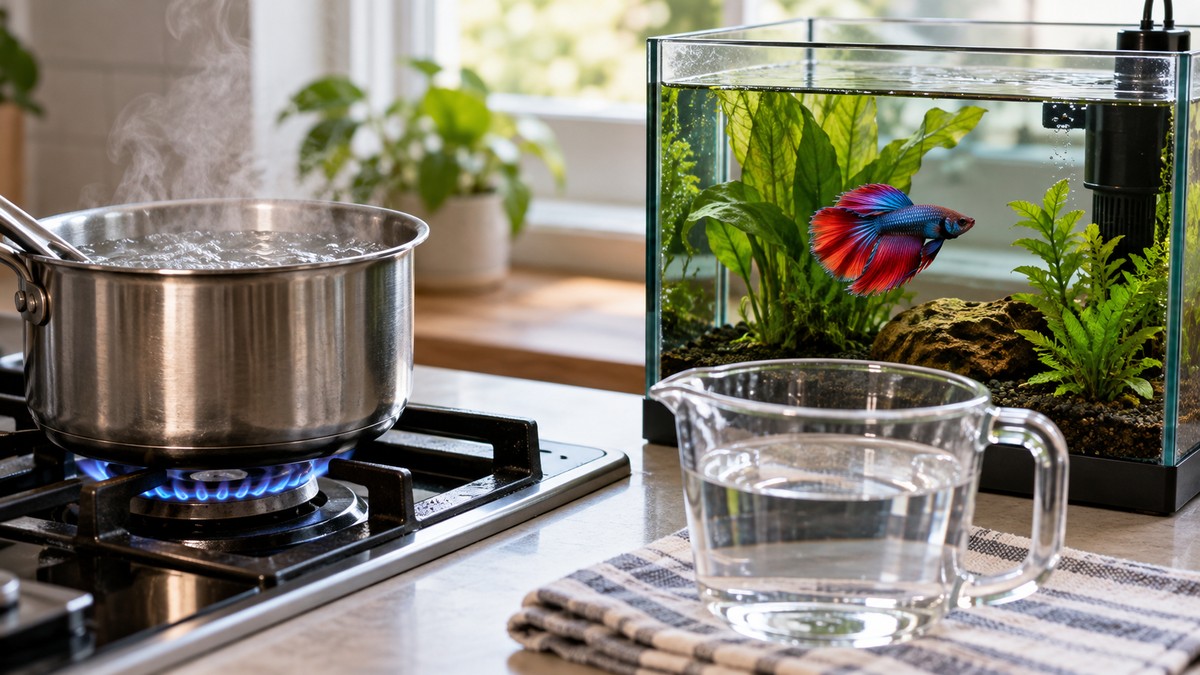
- Use an open pot. A rolling boil in an open pot gives the best off-gassing, according to the article above. The article says to boil for several minutes and gives no exact time.
- Cool it fully. The replacement water should match the tank temperature. The conditioner listing in the product data states that replacement water should be the same temperature as the aquarium. Never add hot water to a fish tank.
- Store it in a clean, closed container. The article says to let the water cool uncovered and then store it in a clean, closed container.
- Still treat for chloramine. If your utility uses it, boiling alone is not enough, so a conditioner or carbon filtration is still needed.
Other approaches exist as well. The article lists granular activated carbon for free chlorine, catalytic carbon for chloramine, and reverse osmosis with carbon prefiltration, along with chemical neutralizers for aquariums. Those are filter and equipment choices, not something this guide can size for your home.
What the conditioner listing says
Tetra BettaSafe Water Conditioner, 1.69 oz
The pack for this post contains one product, so this section is the only product review. The title says it makes tap water safe, neutralizes chlorine, chloramines and ammonia, reduces fish stress, and works in seconds. The bullets repeat that it makes tap water safe for bettas and other ornamental fish, and that it neutralizes harmful chlorine, chloramines, ammonia and heavy metals in aquarium water. They also say to use it when setting up a new aquarium, with monthly partial water changes and when replacing evaporated water.
The dosing text in the spec rows is not entirely consistent between the description and the directions, so read the bottle. The description line says 7 drops per gallon (2 drops per liter). The directions say to shake well and use 14 drops per gallon (4 drops per liter), or 2 capfuls (10 ml) for 10 gallons of water, with each raised mark on the side of the bottle equal to 10 ml. The size listed is 1.69 ounces (50 ml), also sold as a pack of 2. The description also says that if a single betta is kept in a bowl, complete water changes should be performed weekly. Dose per the label on the bottle you actually receive.
Notice that the listing covers chloramine and heavy metals, the two items boiling does not reliably handle. It does not claim to replace a filter or to fix hard water. The listing does not state anything about kill rates, test results or shelf life, so none is given here.
Common mistakes with tap water and bettas
- Assuming that boiling covers chloramine.
- Adding hot or cold water straight to the tank instead of matching the tank temperature.
- Skipping treatment because the water “looks clean”.
- Guessing the dose rather than reading the bottle.
- Forgetting that a bowl without a filter needs more frequent full changes than a larger filtered tank.
Cold or warm water temperature is also a care topic of its own; see whether bettas can live in cold water. If a betta looks unwell after any water change, ask a vet; this guide does not give treatment advice.
FAQ
Does boiling tap water remove chlorine?
It lowers free chlorine. A rolling boil in an open pot speeds off-gassing, and longer boiling removes more.
Does boiling remove chloramine?
Not reliably. The article says chloramine does not readily evaporate and that boiling often leaves enough behind to matter. Letting the water sit does not remove it.
Can I let tap water sit out instead?
That works slowly for free chlorine only. It does not remove chloramine, so check your utility’s report first.
Is boiled water safe to use right away?
No. It must cool to the tank’s temperature first. Store it in a clean, closed container while it cools.
Does a conditioner replace boiling?
For most keepers, yes. The conditioner in the product data lists chlorine, chloramines, ammonia and heavy metals, which covers what boiling misses. Follow the label.
How can I tell which disinfectant my water has?
Check your utility’s annual water quality report or test your tap. The report normally names the disinfectant. The related guide on bottled water for bettas covers another route.
Bottom line
Do not rely on boiling as your only treatment. Check whether your water uses chlorine or chloramine; if it is chloramine, or you do not know, use a conditioner that states chloramine and heavy metals on the label and match the new water’s temperature to the tank.