What Is a Cycled Tank? The Nitrogen Cycle Explained
As an Amazon Associate we earn from qualifying purchases.
What is a cycled tank? A cycled tank is one in which the bacteria that live in the filter and on surfaces have grown enough to convert fish waste into less harmful compounds. The University of Florida ammonia publication describes this as the nitrogen cycle, in which ammonia from fish is converted to nitrite and then to nitrate. A new biofilter needs about six to eight weeks to build up enough bacteria to reduce ammonia and nitrite effectively. Merck Veterinary Manual gives a shorter estimate of four to six weeks for the bacteria to develop in a home aquarium. The sections below explain the process, what the sources say about timing, and how to tell when a tank is ready.
Quick answer
- A cycled tank has an established population of beneficial bacteria that turn ammonia into nitrite and nitrite into nitrate, which is less toxic.
- The University of Florida source says a new biofilter needs six to eight weeks to build up enough bacteria. Merck gives four to six weeks for the same bacteria to develop on their own.
- Test ammonia and nitrite. A tank is generally considered ready when both stay low over time, and that is a judgment the sources support only in general terms.
- Add fish gradually to a new tank. Adding too many at once can overwhelm the bacteria, so this is a step to take after the cycle starts.
How the nitrogen cycle works in a tank
The University of Florida ammonia publication, “Ammonia in Aquatic Systems” (FA031), explains that the nitrogen cycle, also called nitrification, eliminates ammonia from water by converting it to a less toxic compound. Fish excrete ammonia as their primary waste product. Ammonia-oxidizing bacteria convert ammonia to nitrite. A second group, the nitrite-oxidizing bacteria, convert nitrite to nitrate. Nitrate is less toxic, though the publication notes it can build up in closed systems.
Merck Veterinary Manual describes the same process in simpler terms. Beneficial bacteria feed on wastes, which can include uneaten food, decaying plant matter, fish feces, and the ammonia that fish excrete. One type of bacteria consumes ammonia and produces nitrites. Another consumes the nitrites and produces nitrates. Merck notes that these bacteria are common in the environment, and that they develop on their own in four to six weeks.
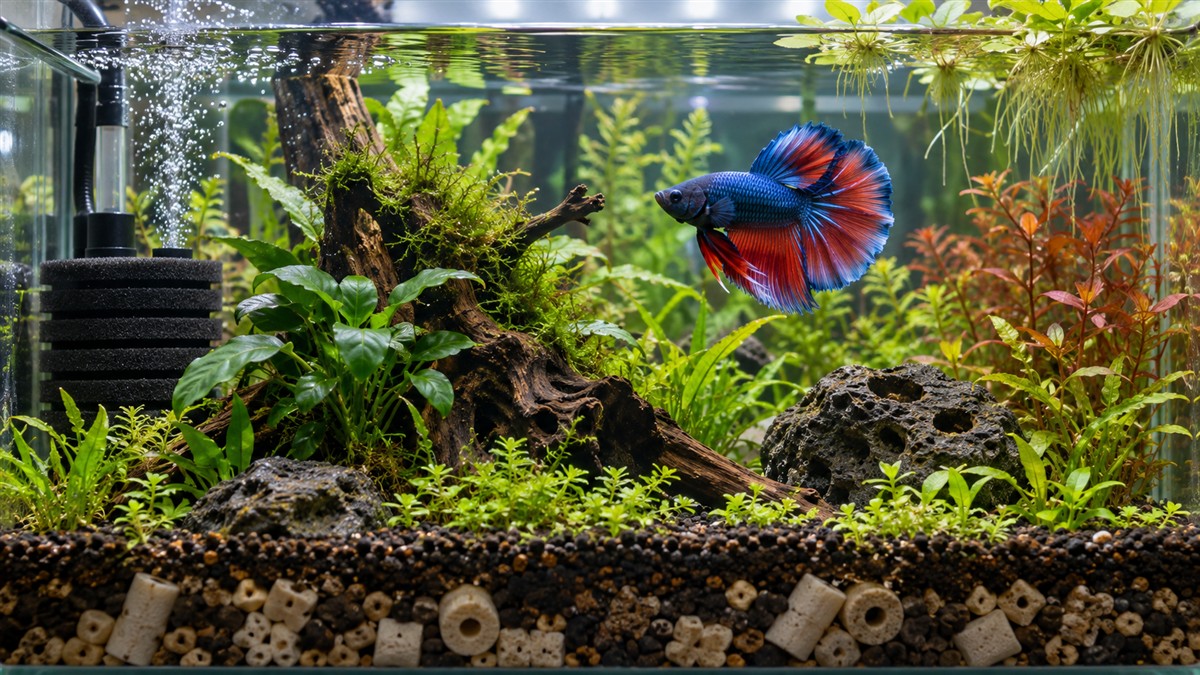
The University of Florida ammonia publication says that in tanks or aquaria, a biological filter, or biofilter, must be provided as a place where bacteria can colonize and flourish. Merck notes that in an under-gravel filter, the gravel itself contains the nitrifying bacteria that remove ammonia, so the filter setup determines where the bacteria live.
Why a cycled tank matters for a betta
Ammonia and nitrite are the two compounds that cause the most immediate trouble. The University of Florida ammonia publication says ammonia is toxic and that, at low concentrations, it causes stress, damages gills, and makes fish more susceptible to infection. It also states that nitrite is toxic to fish at levels as low as 0.10 mg/L. A tank without an established biofilter can allow those levels to rise quickly, especially when fish are added.
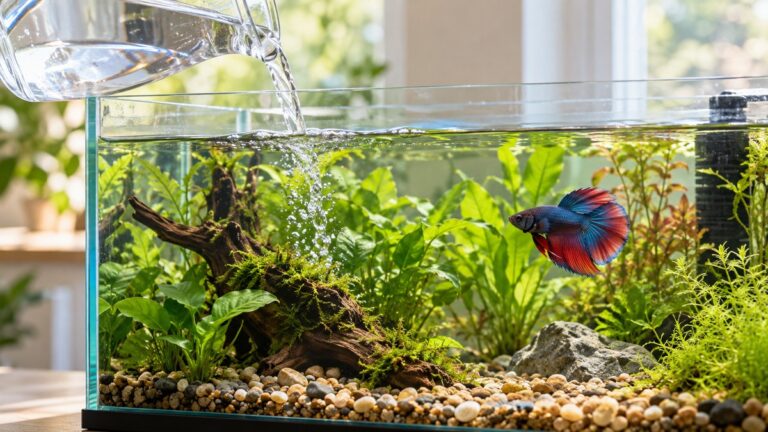
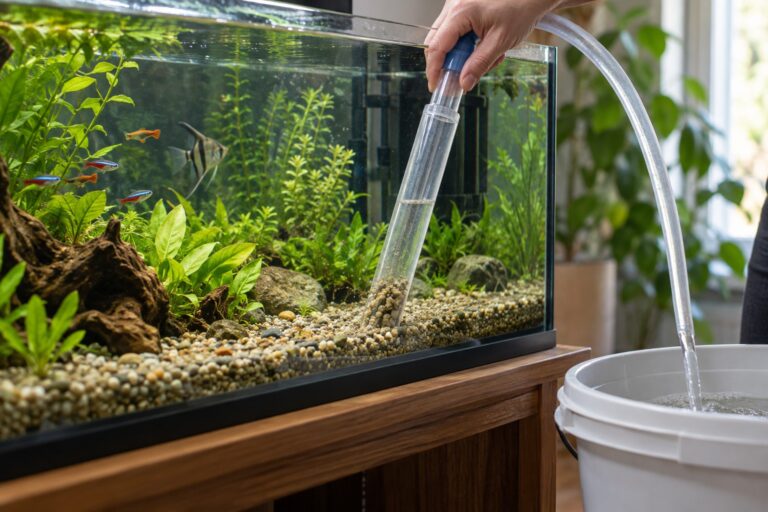
The University of Florida betta publication, “Evolution, Culture, and Care for Betta splendens” (FA212), makes the same point for bettas. It states that uneaten feed, along with ammonia and other dissolved wastes, must not be allowed to reach harmful levels in tanks of limited volume and reduced filtration. It recommends frequent water changes in those tanks. A cycled tank does not remove the need for water changes, but it makes waste control much easier.
Merck adds a practical warning about timing. It states that adding too many fish at once will overwhelm the available bacteria, and toxins will build up quickly. It suggests adding fish gradually, one or possibly two at a time, so the bacteria can grow to match the waste load. That is why a cycle matters before you add a betta, not after.
How long a cycle takes
The two sources give different estimates, and the difference should be noted. The University of Florida ammonia publication says a new biofilter requires six to eight weeks to build up sufficient bacteria to effectively reduce ammonia and nitrite levels. Merck says the bacteria will develop on their own in four to six weeks, and that commercial products may speed up the process slightly but are not necessary for most home aquariums. Both estimates describe a typical timeline. Your tank may take longer or shorter depending on temperature, filter media, and how often you test.
The University of Florida ammonia publication also notes that the bacteria need oxygen and alkalinity to function. If oxygen is low, the bacteria can stop working, and ammonia and nitrite levels increase. The same publication says that at a total alkalinity below 20 mg/L, common nitrifying bacteria do not function effectively. A cycle that stalls can be a sign of a water chemistry problem, not only of time.
Temperature also affects the process. The University of Florida ammonia publication says the portion of un-ionized ammonia increases with pH and temperature, which means ammonia is more toxic in warmer, more alkaline water. The sources do not give a cycling temperature for bettas, but they do state that bettas do not do well in cold water. Keep the tank warm and stable.
How to tell when a tank is cycled
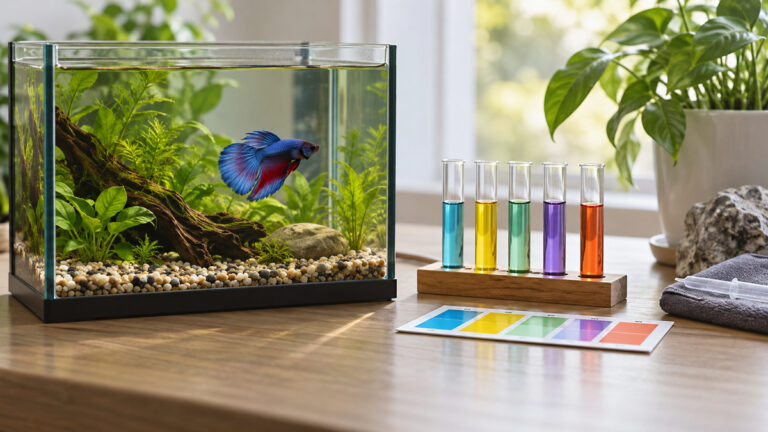
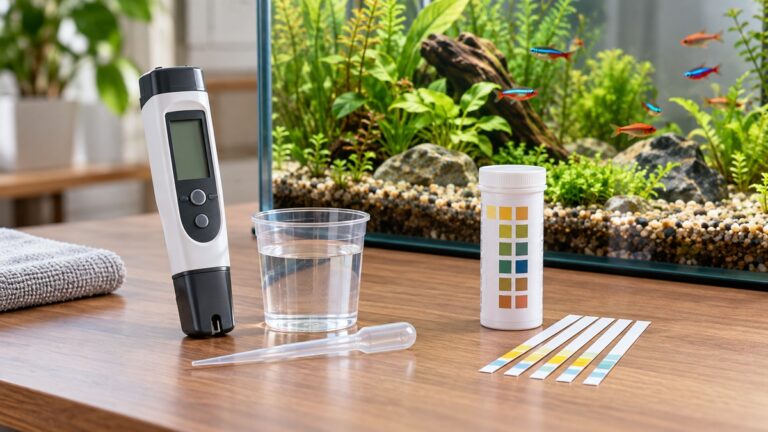
The sources describe testing as the only reliable way to know. The University of Florida ammonia publication explains that ammonia is colorless and odorless at levels that are toxic to fish, so you cannot judge it by looking. It recommends a test kit that measures total ammonia, a pH test, and a thermometer. For nitrite, the same logic applies: a test kit is needed, because the harm happens at concentrations you cannot see.
In practical terms, a tank is generally considered cycled when ammonia and nitrite stay low between feedings and water changes. The sources do not set a single number for “cycled” across all tanks, so this is general guidance. If ammonia or nitrite reads above zero after the tank has been running for weeks, the cycle is not complete or the tank is overloaded. Our guide on the best fish tank water quality test strips covers test options in more detail.
Tap water needs care during this period. Merck explains that most city water is treated with chlorine or chloramine, which are toxic to fish and to the bacteria in the tank. Dechlorinators are available and should be used to treat new water added to the aquarium. Using untreated water during a cycle can kill the bacteria you are trying to grow.
Speeding up a cycle
Merck says commercial products may speed up the process slightly, but are not necessary for most home aquariums. The University of Florida ammonia publication notes that some chemicals used to treat disease, especially antibiotics, can harm nitrifying bacteria. So avoid treatments during a cycle unless an expert has told you to use them. For a product that targets cycling, see our guide to the fish tank cycling kit. Any product is an addition to testing and water changes, not a replacement for them.
The University of Florida ammonia publication also describes stopping or reducing feed when ammonia is present. Uneaten food adds to the load, so a tank in the early stages of cycling should be fed carefully. Stopping feed for a short time can give the bacteria time to catch up, according to the same source.
What we could not verify
The sources we opened describe the nitrogen cycle clearly, but they do not give a single cycling protocol for a betta tank. We could not verify a betta-specific cycling time, a required number of days of testing, or whether any specific brand of bacterial product works in a home aquarium. Claims that a product “instantly cycles” a tank are not sourced here.
What the sources do not say
The sources do not define the word “cycled” in a single sentence, do not state a required test result for a finished cycle, and do not say how many fish a particular tank can cycle with. They also do not compare filter media for cycling. Those points are common in fish-keeping guides, but they are not in the sources this article is based on.
How we chose
This guide explains a biological process, so we selected a university ammonia publication, a university betta publication, and a veterinary reference. We chose sources that describe the nitrogen cycle directly and that discuss timing with a stated basis. We did not use retail product pages, and we did not use cycling claims from listings as facts.
Frequently asked questions
How do I know if my tank is cycled?
Test for ammonia and nitrite regularly. The sources describe a tank with an established biofilter as one where these compounds are reduced, not one with fish in it. A tank that still shows measurable ammonia or nitrite after weeks is not yet reliable for a betta.
How long does it take to cycle a fish tank?
The University of Florida source says six to eight weeks for a new biofilter to build up enough bacteria. Merck gives four to six weeks for the bacteria to develop on their own. Test the water rather than relying on a fixed date.
Can I add a betta to a tank that is still cycling?
The sources do not advise adding fish to an uncycled tank. Merck says adding too many fish at once overwhelms the bacteria, and the University of Florida ammonia publication says ammonia and nitrite can harm fish at low levels. Wait until the tank tests stable before adding a betta.
What does ammonia do to fish?
The University of Florida ammonia publication says low levels of ammonia cause stress, damage gills, and make fish more susceptible to infection, and that high levels can kill them. The effect depends on pH and temperature, because the more toxic form becomes a larger share at higher pH and temperature.
Do I need to use bacteria products to cycle a tank?
Merck says commercial products may speed up the process slightly, but are not necessary for most home aquariums. The sources do not say which product works best, so testing and patience remain the core method.
Sources
- University of Florida IFAS Extension, “Ammonia in Aquatic Systems” (FA031), https://edis.ifas.ufl.edu/publication/FA031, opened 2026-10-24.
- Merck Veterinary Manual, “Providing a Home for Fish,” https://www.merckvetmanual.com/all-other-pets/fish/providing-a-home-for-fish, opened 2026-10-24.
- University of Florida IFAS Extension, “Evolution, Culture, and Care for Betta splendens” (FA212), https://edis.ifas.ufl.edu/publication/FA212, opened 2026-10-24.